
Article In Short:
More data helps when uncertainty comes from missing information, but it fails when the situation itself is still evolving. If analysis increases detail but not confidence, it’s time to act and learn. Read on to know how.
When more data doesn’t lead to better decisions
You’ve already run the numbers three times. The model improved, but your confidence didn’t.
In many organizations, the response to uncertainty is almost automatic. What happens is this:
- If the situation is unclear, more data is gathered.
- If outcomes are disappointing, analysis is extended.
- If disagreement persists, additional evidence is requested.
The underlying assumption is rarely questioned: that with enough information, the situation will become sufficiently clear to support a confident decision.
In many cases, this assumption holds, but not always.
There are also situations in which data accumulation does not lead to greater clarity and may, in fact, make it harder to move forward.
Two fundamentally different situations
Not all uncertainty is the same. That is where the confusion begins.
1. Uncertainty as missing information
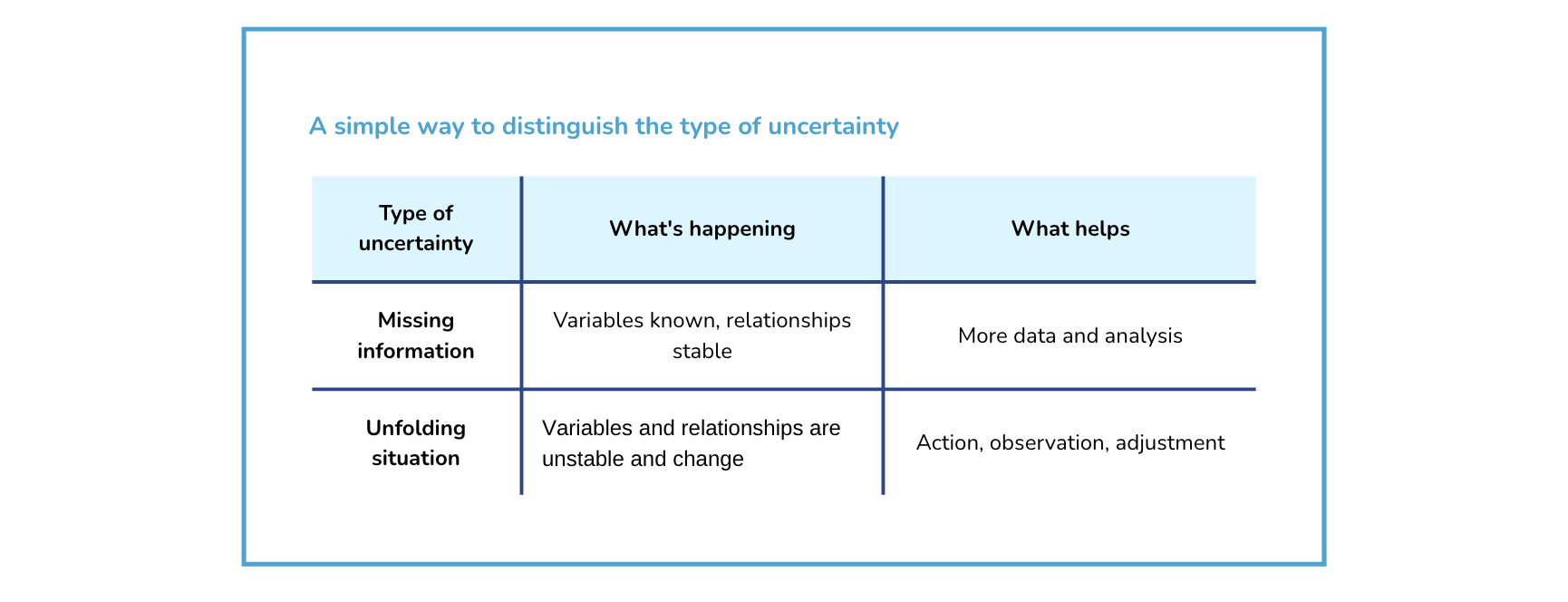
There are situations in which uncertainty arises primarily from incomplete information. The relevant variables are known, the relationships between them are reasonably stable, and the task is to reduce gaps in understanding. In such cases, better data leads to better decisions.
Example:
Consider a company deciding whether to expand production capacity for an existing product line in a mature market. The competitive landscape is known, demand patterns are relatively stable, and cost structures are well understood. The key question is how much capacity to add and when.
In these cases, uncertainty is like a puzzle—you don’t yet see the full picture, but the pieces are there. With enough work, it comes together.
2. Uncertainty as an unfolding situation
There are situations in which key aspects of the future cannot be known in advance, not because the data is missing, but because the situation itself is still unfolding. The relationships between variables are not yet stable, and the range of possible outcomes cannot be fully specified.
Example:
Consider a company deciding whether to commit to a new technological trajectory—for example, investing heavily in a transition to a new production method or energy source.
The outcome depends on how competitors respond, how regulation evolves, how supply chains adapt, and whether complementary technologies mature in time.
Each strategic move influences others' behavior. The system is not fixed—it is reacting.
Here, uncertainty is more like weather—you are inside something that is still developing. More data may sharpen your view of the present. It does not make the future more predictable.
When the analysis begins to stall progress
A common pattern emerges in these situations.
As uncertainty persists, the organization increases its investment in analysis. Scenarios are refined, forecasts are updated, and models become more elaborate. Each iteration produces incremental improvements in understanding, but not a corresponding increase in confidence about what to do next.
At the same time, decisions are deferred. Not explicitly, but through a continued search for clarity that remains just out of reach.
From within the organization, this can feel like rigor. From the outside, it often appears to be hesitation.
What is clarity is not coming?
The difficulty of recognizing the limit
One challenge is that there is no clear point at which additional data stops being helpful.
Each additional dataset or analysis appears to bring the organization closer to resolution. The distinction between “almost enough information” and “information that will never be sufficient” is not easily made in real time.
As a result, the organization can remain in an extended analysis mode longer than is useful while the situation continues to evolve.
When more data increases exposure
There is a further complication.
When decisions are delayed in the expectation of greater clarity, the organization may become more exposed rather than less. Competitors move, technologies develop, stakeholder expectations shift. By the time a decision is made, the conditions under which it was initially framed may no longer apply.
Alternatively, the organization may proceed with a decision that appears well-supported, but rests on assumptions that are more fragile than they seem. In such cases, the presence of extensive data can create unwarranted confidence.
👉 A quick self-check
If you are in the middle of this process, ask:
- Do we know the key variables?
- Are the relationships between them stable?
- Has more analysis increased confidence—or just detail?
If the answer is “more detail, not more confidence,” you are likely dealing with an unfolding situation.
What changes once you see this
Recognizing that more data will not always resolve uncertainty does not mean that data becomes irrelevant. It remains essential for understanding what is happening.
But its role changes.
Instead of serving as the basis for eliminating uncertainty, data becomes one input into a process of acting, observing, and adjusting. The emphasis shifts from waiting for a complete picture to working with a partial and evolving one.
This has implications for how decisions are made.
Instead of asking:
“Do we have enough information to commit?”
The question becomes:
“Can we take a next step that teaches us something without locking us in?”
👉 What you can do next
If you recognize this pattern, there are several ways forward:
- Run a small, reversible experiment
- Test one critical assumption in practice
- Take a step that generates new information
- Limit further analysis to what directly informs action
For example:
Instead of committing to a full rollout, a company might test a limited version in one region—not to succeed immediately, but to learn how the system responds.
The goal is not to eliminate uncertainty.
It is to move within it.
Learnings
The idea that more data leads to better decisions is not wrong, but it is incomplete.
-
If uncertainty is primarily about missing information, then investing in better data and analysis is the right response.
-
If uncertainty reflects a situation that is still unfolding, then additional data will not stabilize it, and waiting for clarity may delay necessary action.
-
When analysis continues without increasing confidence, it may signal that the limits of what data can provide have been reached.
-
Decisions can be designed not only to achieve outcomes, but also to generate information that was not available in advance.
-
Progress, in such cases, depends less on reaching certainty than on maintaining the ability to adjust as the situation develops.
This shifts the role of data from something that resolves uncertainty to something that helps you work with it.
Fresh Foresight Insights Directly in Your Inbox
Join Barbara's mailing list to receive her latest Canary and updates about her research into managerial foresight and blind spots.
I hate SPAM too, so know that I won't spam or have others spam you!
