

There is a familiar moment in many organizations, although it is rarely described in quite the same way...
A strategy has been carefully developed. The analysis is solid, the assumptions are discussed, stakeholders have been aligned, and there is a clear sense that, given what is known at the time, the chosen direction is reasonable. For a while, things appear to move as expected.
And then, gradually, something shifts.
It is not usually a dramatic failure. Rather, it is a series of small adjustments that begin to accumulate. Forecasts are revised, timelines stretch, and earlier decisions are revisited. Elements that once seemed stable start to feel provisional. What was initially framed as a clear path forward is beginning to look more like a series of corrections.
At that point, the explanation tends to follow a well-established pattern. The issue is located in execution. Perhaps coordination has been insufficient, or accountability unclear, or the level of discipline not quite where it should be. The response, accordingly, is to strengthen control: more frequent reporting, sharper targets, closer monitoring.
In some cases, this is entirely appropriate.
But there are also situations in which this explanation, while plausible, does not quite capture what is happening.
When the logic of planning no longer holds
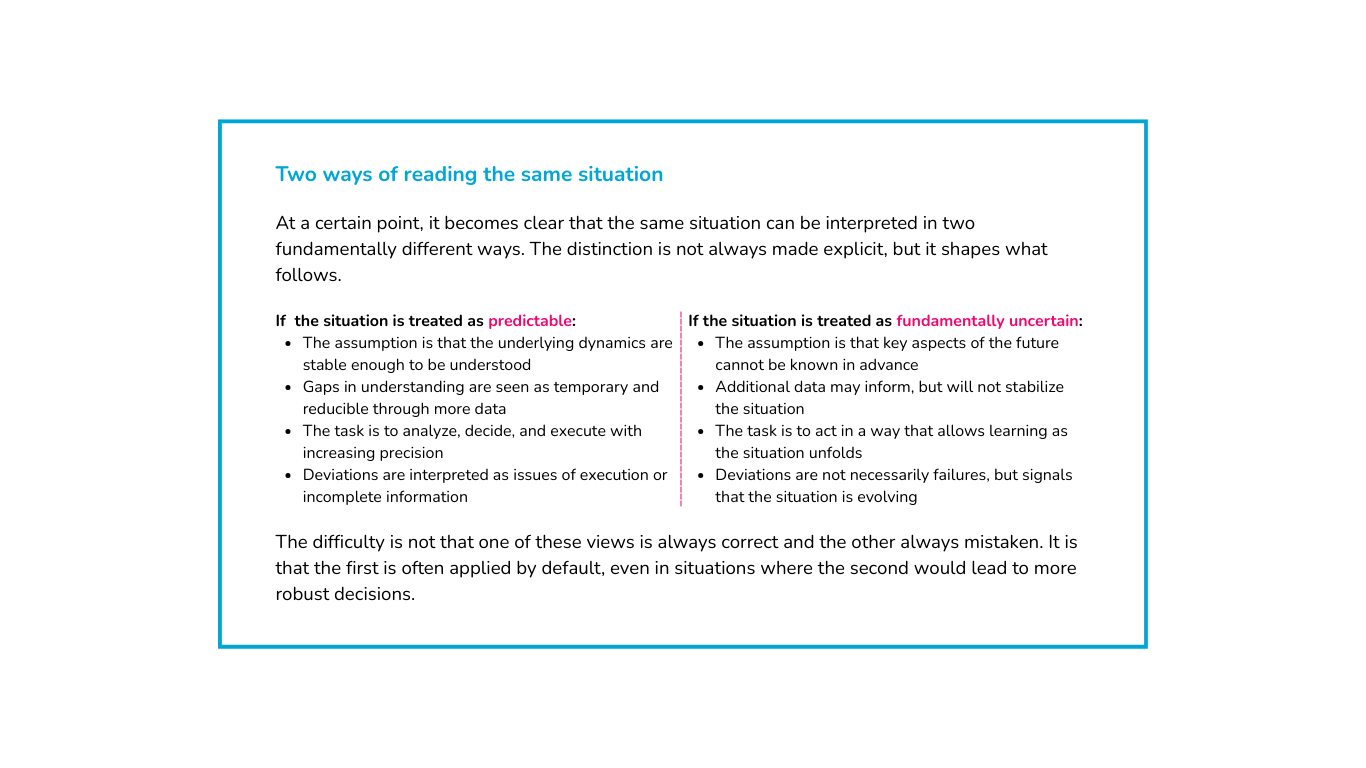
Most management approaches are built on a set of underlying assumptions about the nature of the environment in which decisions are made. They assume that, although the future is not perfectly known, it is sufficiently stable that cause and effect can be understood, at least retrospectively, and that additional information will improve the quality of decisions.
Within that frame, the sequence of analysis, decision, and implementation is both logical and effective. If outcomes disappoint, it makes sense to look for execution weaknesses, since the problem's structure is assumed to be sound.
The difficulty arises when that underlying structure no longer holds.
There are situations in which the environment does not remain stable long enough for analysis to settle. While the organization is still in the process of understanding the problem, the problem itself evolves. New actors enter, existing actors change direction, and what counts as a desirable outcome becomes contested. In such cases, it becomes less clear whether the issue is the execution of the plan or whether the plan rests on an assumption of stability that no longer holds.
The limits of better information
In response to this kind of instability, organizations often intensify their search for information. If the picture is unclear, the natural assumption is that it can be clarified with more or better data. This is, in many situations, a sensible and effective response.
However, there are also situations in which additional data does not resolve the uncertainty in any meaningful way. Not because the data is of poor quality, but because the future has not yet taken a form that can be captured through analysis. In these cases, waiting for clarity can lead to costly delays, while acting as if clarity will eventually emerge can result in commitments that prove difficult to unwind.
Looking back, it is often tempting to interpret such outcomes as failures of judgment or execution. Yet at the time decisions were made, they were frequently consistent with the information available and the logic that guided the organization’s approach.
A different way of interpreting what is happening
This suggests a slightly different reading of situations in which strategies appear to falter.
Rather than assuming execution has broken down, it may be worth considering whether the situation has been treated as more predictable than it actually is. The distinction is subtle, but it has significant implications. A situation that is genuinely uncertain in the sense that its development cannot be known in advance requires a different kind of response than one in which uncertainty is primarily a matter of incomplete information.
The challenge, then, is not only to decide what to do but to understand what kind of situation one is dealing with in the first place.
What does this change in practice
If the situation is one in which additional information will eventually stabilize the picture, then investing in better analysis and stronger execution remains the appropriate course of action. But if the path forward can only become visible as events unfold, the role of strategy shifts.
Instead of defining a clear end state and working backward, strategy becomes a matter of shaping a sequence of moves that allow the organization to learn as it proceeds. This involves making commitments that are, where possible, reversible, testing assumptions in practice rather than embedding them in large-scale plans, and remaining attentive to how the situation evolves over time.
This does not imply a lack of rigor. On the contrary, it requires a different form of discipline—one that is less focused on enforcing adherence to a predefined plan, and more concerned with maintaining awareness of how and why the situation is changing.
A small but consequential shift
Seen in this light, the question of execution takes on a different character.
Before concluding that a strategy is underperforming because it has not been implemented effectively, it may be useful to pause and ask whether the strategy itself presupposes a degree of predictability that the situation does not in fact offer.
If that is the case, then improving execution, while still important, will not be sufficient. The more fundamental issue lies in how the situation has been understood, and therefore in how the strategy has been constructed.
From there, it becomes easier to see why, in some contexts, more data does not resolve the difficulty, why certain problems resist stable definition, and why progress depends less on arriving at the right answer than on making the next move in a way that keeps options open and learning possible.
Learning:
What follows from this is not a rejection of planning or execution, but a more careful positioning of both. Before tightening control or refining implementation, it is worth asking what kind of situation you are actually dealing with.
-
If the situation can, in principle, be clarified with better information, then investing in analysis and strengthening execution remains appropriate.
-
If the situation cannot be stabilized in advance, then applying those same tools more rigorously may deepen the problem by locking you into assumptions that will not hold.
-
In those cases, the task shifts from optimizing a plan to managing exposure: making smaller, more reversible commitments and avoiding early decisions that are difficult to unwind.
-
Assumptions need to be treated as hypotheses to be tested in practice, rather than as foundations for large-scale commitments.
-
Direction emerges through a sequence of informed moves, not from a single, fixed design established at the outset.
This does not reduce the need for discipline; it changes where that discipline is applied.
Fresh Foresight Insights Directly in Your Inbox
Join Barbara's mailing list to receive her latest Canary and updates about her research into managerial foresight and blind spots.
I hate SPAM too, so know that I won't spam or have others spam you!
